Mesa’s transformation from a modest agricultural settlement founded in 1878 to Arizona’s third-largest city has brought relentless demand for residential and commercial infrastructure across the Salt River Valley. Much of this expansion sits atop Quaternary alluvial deposits — loose sandy silts and clean sands deposited by ancient river channels — which present real challenges for shallow foundations. While standard compaction works for near-surface layers, deeper loose zones demand a different approach entirely. Our laboratory team develops vibrocompaction design packages that specify depth, grid spacing, frequency, and verification testing for sites across Mesa, drawing on extensive local CPT and SPT data to calibrate the densification process before the first vibroflot ever hits the ground.
Clean sands in Mesa can reach 85% relative density after well-designed vibrocompaction, eliminating post-construction settlement risks entirely.
Our approach and scope
The desert climate of Maricopa County creates a specific challenge for densification projects: extremely dry granular soils with low moisture content can resist rearrangement during vibratory energy input. Mesa’s coarse alluvium, particularly in the Lehi and Dobson Ranch areas, often requires pre-wetting or water-assisted vibroflotation to achieve the target relative density above 70%, as mandated by the Mesa building code referencing IBC Section 1804. Our design process integrates laboratory grain-size analysis (ASTM D2487) and maximum/minimum density testing (ASTM D4253/D4254) to predict the soil’s response to vibration. We model the compaction radius based on in-situ fines content — clean sands compact efficiently, while silty sands above 12% passing the #200 sieve need careful energy adjustment, which we specify in the field operations plan.
Local geotechnical context
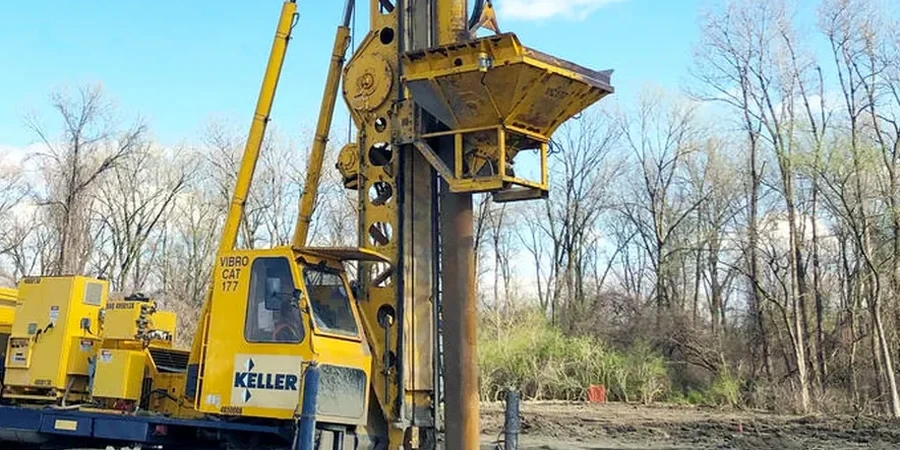
A hydraulic vibroflot module suspended from a crawler crane is the workhorse of every Mesa densification site — a steel cylinder roughly 3 meters long and 40 centimeters in diameter, equipped with eccentric weights spinning at 1,800 rpm that generate radial acceleration transmitted directly into the soil skeleton. When the operator lowers it to the design depth using water jets or compressed air, the surrounding granular structure collapses and rearranges into a denser state. The risk we mitigate through design is undetected heterogeneity: if a thin clay lens lies within the treatment zone, the vibratory energy dissipates without achieving compaction, leaving a weak pocket that can differential-settle later. Our design maps require pre-treatment electric cone penetration testing at tight spacing to flag such inclusions before mobilization, saving Mesa builders from costly rework.
Common questions
What does vibrocompaction design cost for a typical Mesa residential lot?
Design fees for a standard single-family residential lot in Mesa generally range from US$1,580 to US$4,680, depending on the depth of loose soil and the number of verification CPT soundings required to satisfy city reviewers. Larger commercial parcels or multi-family projects involve more extensive pre-treatment investigation and a denser grid, which moves the fee toward the upper end.
How deep can vibrocompaction treat loose soils in the Mesa area?
Our designs routinely address loose zones down to 35 meters below grade, which covers the deepest alluvial channels mapped in the East Valley. The practical limit depends on the crane capacity and vibrator power available, but for most Mesa projects with loose layers extending 10 to 20 meters, standard 130 kW vibroflots operate without difficulty.
Is vibrocompaction effective in silty sands common in parts of Mesa?
It works, but with reduced efficiency. When fines content exceeds 12 to 15 percent, the silt dampens the vibratory energy and slows the densification process. Our design compensates by tightening the grid spacing and increasing the hold time per lift. We always run laboratory grain-size analysis first to predict whether the soil is a candidate for standard vibrocompaction or if an alternative like stone columns might perform better.
How do you verify the compaction was successful?
We specify post-treatment cone penetration testing as the primary verification method because it provides a continuous profile of tip resistance and sleeve friction, allowing us to calculate the relative density at every depth. The standard protocol requires one CPT sounding per 100 square meters of treated area, and we compare the results directly against the pre-treatment baseline to document the improvement factor before signing off.