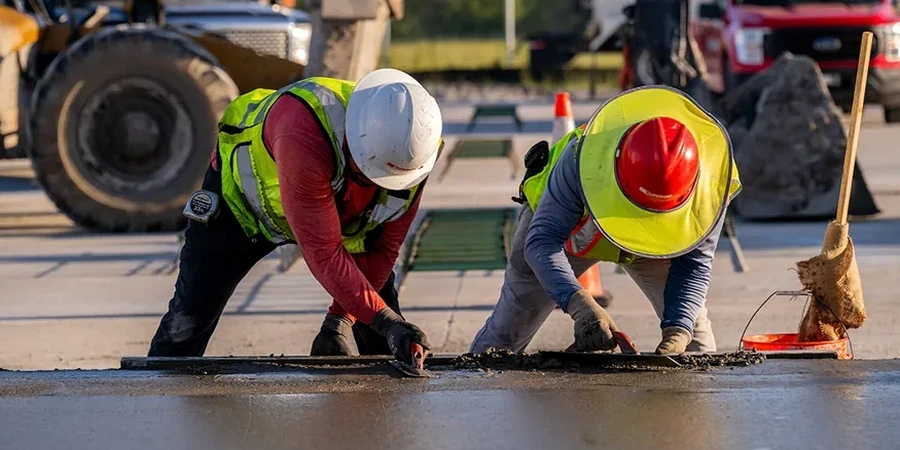
We reviewed a warehouse expansion off the US-60 last year where the contractor had already poured 200 feet of rigid pavement before calling us. The slab was showing hairline cracks within six weeks, and the owner was looking for answers. The core issue was a lens of fat clay that the original investigation missed entirely—the material was swelling and shrinking with every irrigation cycle from the adjacent landscaping. In Mesa, rigid pavement design is never just about the concrete mix or the dowel basket. It hinges on what's happening two feet below the bottom of the slab. A proper CPT test can map those hidden soft zones continuously, and when we pair that with Atterberg limits on select samples, the picture becomes actionable. Our team has worked on everything from residential cul-de-sacs in Dobson Ranch to arterial roadways out near the Gateway corridor, and the consistent lesson is that the subgrade support condition dictates the long-term performance of the pavement far more than the flexural strength of the concrete itself.
In Mesa's Sonoran Desert climate, the difference between a 30-year pavement and a 5-year failure is usually not the concrete—it's the uniformity of the subgrade support across the slab footprint.
Local geotechnical context
The Sonoran Desert throws two extremes at rigid pavement that milder climates don't see to the same degree. First is the daily temperature swing—Mesa can see a 40-degree drop from afternoon to pre-dawn in the spring, and that differential creates severe upward curling at panel edges while the center remains supported. If truck traffic runs those curled edges before the slab settles back down, you get corner breaks that propagate fast. Second is the monsoon effect: a bone-dry subgrade in June becomes saturated in July after a single microburst, and the moisture front moves upward through capillary action. If the base course lacks positive drainage or the subgrade has high plasticity, you're suddenly supporting the slab on a softened, non-uniform layer. We've seen this exact failure mechanism on collector streets in the Superstition Springs area. The fix is never just patching the concrete—it requires rethinking the rigid pavement design from the subgrade up, often incorporating a seismic refraction survey to map the bedrock profile and verify that the treatment depth is adequate for the long-term moisture regime.
Regulatory framework
ASTM D1196/D1196M – Standard Test Method for Nonrepetitive Static Plate Load Tests of Soils and Flexible Pavement Components, ASTM D2487 – Standard Practice for Classification of Soils for Engineering Purposes (Unified Soil Classification System), ASTM C1435/C1435M – Standard Practice for Molding Roller-Compacted Concrete in Cylinder Molds, ACPA TB021P – Design of Concrete Pavement for Streets and Roads, ADOT Standard Specifications Section 310 – Portland Cement Concrete Pavement, IBC Chapter 18 – Soils and Foundations (Mesa adoption with local amendments)
Common questions
What does rigid pavement design cost for a commercial parking lot in Mesa?
For a typical commercial parking lot or small roadway segment in Mesa, the geotechnical investigation and rigid pavement design package typically runs between US$2,020 and US$6,970. The range depends on the number of borings or CPT soundings required, whether we need to run plate load tests for k-value verification, and the complexity of the joint detailing if the lot has irregular geometry or heavy truck lanes. We deliver a fixed-scope proposal before any fieldwork starts so there are no surprises.
How deep do you investigate the subgrade for a rigid pavement?
We typically explore to a depth of at least four feet below the proposed subgrade elevation, or deeper if we encounter materials that suggest a deeper zone of influence. The concept is to capture the full depth of the moisture-active zone—in Mesa's climate, the upper three to four feet of soil sees the most seasonal volume change. If we find fat clays or loose alluvial deposits extending deeper, we'll push the borings further to make sure we're not missing a compressible layer that could cause differential settlement under traffic loads.
Do you handle both the geotechnical investigation and the actual pavement thickness design?
Yes, we deliver the complete package. Our field crew handles the subsurface exploration—whether that's hollow-stem auger borings, CPT soundings, or hand-auger sampling for smaller sites—and our engineering team takes the lab data (strength, consolidation, plasticity) and translates it into a pavement design that meets ACPA and ADOT standards. We deliver a stamped report that includes subgrade characterization, k-value recommendations, base course specifications, joint layout drawings, and construction QA/QC thresholds. The contractor or municipality can then take that package straight into construction without needing a separate design consultant.