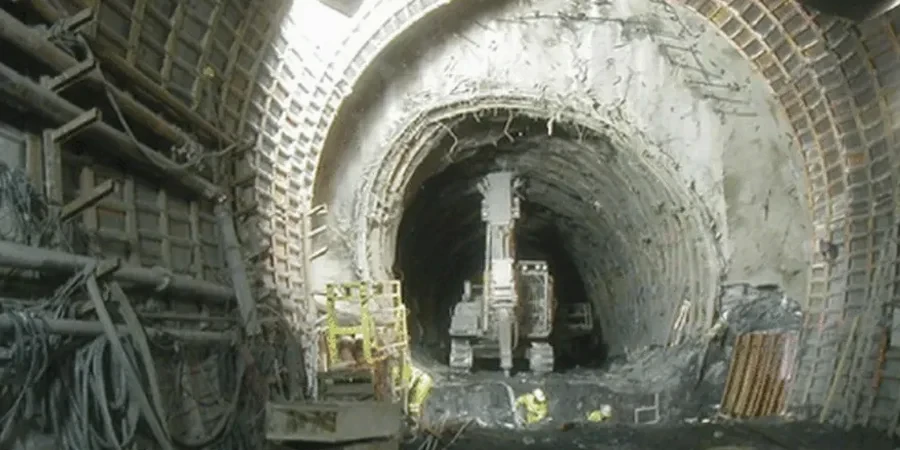
The EPB machine cuts through Mesa's fluvial deposits, where cemented sands and interbedded caliche create a mixed-face condition that challenges any tunneling protocol. Our lab analyzes Shelby tube samples and SPT split-spoon recoveries to quantify the cementation index and the abrasivity of the quartz-rich Salt River gravels. Without precise grain-shape data and Atterberg limits on the clay seams, an earth pressure balance shield can clog or over-excavate within a single ring. We pair index testing with triaxial consolidated-undrained runs at confining pressures matching the planned cover depth. This gives the contractor a working range for face pressure and screw conveyor torque before the first cutterhead enters the ground. We also run in-situ permeability falling-head tests in boreholes to bracket pore pressure dissipation rates across the interbedded sequence.
In Mesa's cemented alluvium, predicting the transition from caliche hardpan to loose sand within a single ring is the difference between steady advance and a sinkhole at the surface.
Local geotechnical context
A microtunnel drive under Broadway Road encountered a five-foot-thick loose sand lens sandwiched between two caliche ledges. The face pressure had been set for cemented ground; when the shield entered the lens, the face blew out into the screw conveyor, the plenum lost pressure, and a chimney propagated to the asphalt within fifteen minutes. Traffic control and a two-week emergency grouting program turned a routine drive into a claim. We now map these lenses with a combination of resistivity tomography and high-density CPT grids, detecting low-resistivity, low-tip-resistance pockets that standard borings on 100-foot centers routinely miss. Where the tunnel alignment intersects known paleochannels of the Salt River, we recommend a grouting pre-treatment program from the surface to consolidate the running ground before the shield arrives. For shallow urban crossings under Apache Junction utilities, a penetration test every ring is cheap insurance compared to a utility strike or a road closure.
Regulatory framework
ASTM D1586 / D4633 (SPT and energy calibration), ASTM D5778 (CPT with pore pressure measurement), ASTM D2487 (Unified Soil Classification System), ASTM D4644 (Slake durability of shale and weak rock), ASCE 7-22 (Minimum design loads), IBC 2024 (International Building Code, geotechnical chapter 18)
Common questions
What is the typical cost range for a soft-ground tunnel geotechnical investigation in Mesa?
Budget between US$3,580 for a limited scope on a short drive and US$15,580 for a full alignment characterization with CPT, coring, geophysics, and a complete laboratory conditioning suite. The spread depends on the number of access borings, the depth to the tunnel horizon, and whether we need to close lanes on major arterials like Southern Avenue.
How do you handle the caliche variability that is typical of the Mesa area?
We treat caliche as a discontinuous cemented horizon, not a stratiform rock unit. Our field program includes continuous core logging with RQD and fracture spacing measurements, plus CPT soundings at offset locations to catch lateral pinch-outs. In the lab we run slake durability and point-load tests to bracket the strength range. The ground model we deliver segments the alignment into reaches of similar cementation index so the contractor can plan tool changes and conditioning mixes reach-by-reach.
What laboratory testing is essential for EPB tunneling in cemented alluvium?
At minimum you need grain-size distribution with hydrometer, Atterberg limits, and permeability on each distinct unit. Add slake durability on caliche, petrographic examination for quartz content and particle angularity, and consolidated-undrained triaxial tests on the clay seams. For conditioning, we run mixing tests with candidate foam agents at the lab's ambient temperature before the contractor commits to a full-scale trial on site.