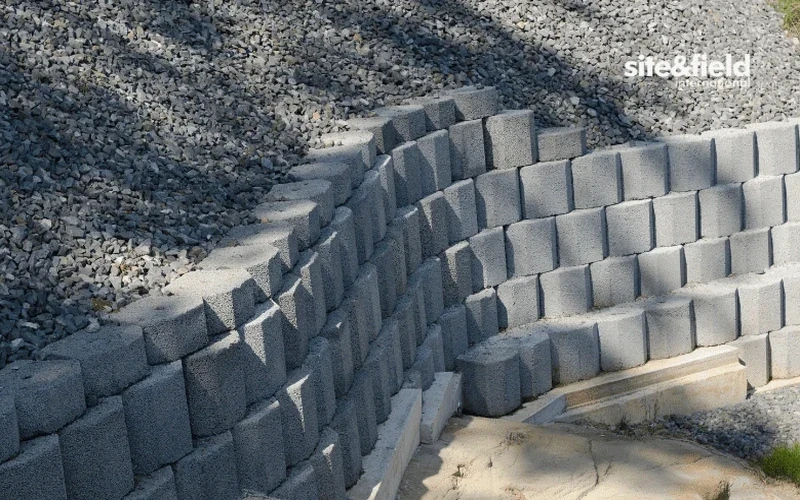
The transition from Mesa’s irrigated agricultural legacy to rapid urban expansion has created a specific set of subsurface challenges. The valley floor, punctuated by calcic horizons—locally known as caliche—demands a retaining wall design approach that accounts for cementation variability and erratic groundwater perched above the hardpan. Unlike the free-draining granitic decomposition found in the Phoenix Mountains, the sedimentary deposits here hold moisture unpredictably, increasing lateral earth pressures behind the wall face. When a site sits near the historic Consolidated Canal alignment, we often combine a preliminary CPT test with laboratory index testing to differentiate between collapsible silts and stiff clayey layers. This data feeds directly into the wall geometry, ensuring the final structure handles not only static loads but also the swelling potential typical of the region’s clay fractions.
Caliche layers in Mesa can transition from soil to rock-like material within a single borehole, dramatically altering the required wall embedment depth.
Local geotechnical context
A recent evaluation for a 14-foot cantilever wall near the Superstition Freeway illustrated the failure risk of ignoring stratigraphic anomalies. The initial borings identified stiff clay, but a secondary investigation revealed a pocket of loose, saturated silt trapped above a caliche lens. Without a slope stability analysis that captured this weak seam, the global stability factor would have fallen below the ASCE 7 minimum. The project team revised the design to include a deeper keyway and a gravel drainage chimney, cutting off the water migration path. In Mesa, the biggest threat isn’t always the wall overturning—it’s the slow, progressive failure of the soil mass behind it, driven by irrigation runoff or stormwater infiltration that softens the backfill structure over time.
Common questions
What is the typical cost range for retaining wall design in Mesa?
For a standard residential or light commercial cantilever wall, the engineering design and soil investigation typically range between US$1,060 and US$3,910 depending on wall height, site access, and the extent of required laboratory testing.
How does Mesa's caliche layer affect retaining wall design?
Caliche acts as a natural cementation layer, offering high bearing capacity but also creating a barrier to water infiltration. We treat it as a weak rock stratum; wall footings can bear on it directly if it is continuous, but we must design drainage to prevent water pressure buildup at the interface between the caliche and the overlying soil.
Do I need a retaining wall permit in the City of Mesa?
Yes, any retaining wall over 4 feet in height, measured from the bottom of the footing to the top of the wall, requires a building permit. Walls supporting a surcharge or located in critical drainage areas may require additional review regardless of their height.