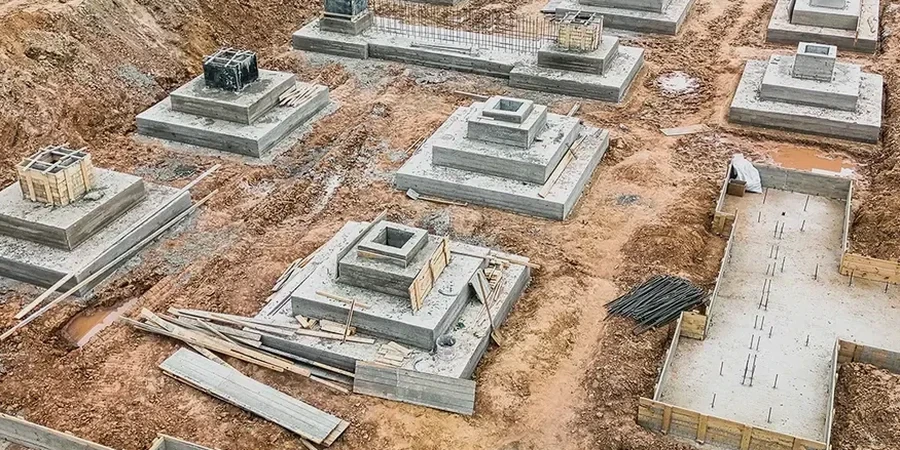
Mesa sits at 1,240 feet elevation across the eastern edge of the Salt River Valley, where the subsurface tells a story of ancient alluvial deposits, caliche layers, and pockets of expansive clay that have challenged builders since the city incorporated in 1883. With over 500,000 residents now spread across 138 square miles, the demand for reliable infrastructure keeps growing. The challenge is the soil itself: collapsible zones, sulfate-rich ground, and a seismic setting that demands careful load transfer. Pile foundation design addresses these conditions by bypassing the active zone of shrink-swell and transferring structural loads to competent bearing strata. Our geotechnical team runs site-specific investigations to model skin friction and end-bearing capacity before selecting pile type, diameter, and embedment depth. For sites near the Usery Mountain foothills or the Red Mountain corridor, we often pair deep borings with CPT testing to capture continuous soil profiles without gaps.
Mesa's caliche is not a reliable bearing layer: it dissolves, fractures, and hides expansive clays beneath. Deep foundations are the only way to bypass that uncertainty.
Local geotechnical context
Mesa lies within Seismic Design Category B or C depending on the neighborhood, but the bigger threat to pile performance here is not shaking: it is expansive soil and collapsible ground. The Pleistocene-age Mesa terrace deposits contain clay layers with liquid limits above 50 and plasticity indices exceeding 30. These soils exert uplift pressures on pile shafts during wetting cycles, and if the neutral plane is misidentified, the pile can carry negative skin friction equal to 20 to 40 percent of the structural load. Downdrag does not announce itself; the first sign is usually a cracked slab or a misaligned elevator rail months after construction. Another risk emerges when contractors overexcavate for pile caps in summer and leave the hole open overnight: the desert soil dries, shrinks, and loses side shear capacity by morning. Our designs include clear specification notes on construction sequencing, moisture conditioning, and pile load test timing to close these execution gaps before they become structural problems.
Regulatory framework
IBC 2021 Chapter 18 (Soils and Foundations), ASCE 7-22 Chapter 12 (Seismic Design), ACI 318-19 (Structural Concrete – durability and cover), ASTM D1143 (Static axial compressive load test), ASTM D2487 (Soil classification), ASTM D3689 (Micropile load testing), Maricopa County Building Code amendments
Common questions
How deep do piles typically need to go in Mesa to reach competent bearing?
Depth varies block by block. In the central Mesa area near Main Street, competent bearing in dense alluvium or cemented conglomerate often appears between 30 and 55 feet. Near the Salt River floodplain or reclaimed agricultural land, piles may extend to 70 feet or more. We determine the exact tip elevation from borehole data and CPT refusal depths, never from a generic rule of thumb.
What does a pile foundation design package cost for a Mesa single-family home?
For a single-family residence requiring 8 to 16 piles, the design package including geotechnical investigation, capacity calculations, and sealed drawings typically falls between US$1,680 and US$5,850. The range depends on site access, depth of exploration, number of load tests required, and whether a liquefaction study is needed.
Do Mesa building officials require pile load testing or can we use theoretical capacity?
The City of Mesa Building Safety Division, following IBC 2021 Section 1810, requires load testing when the design capacity exceeds allowable values based solely on static formulas. Most commercial projects trigger at least one static test per pile type. Residential projects can sometimes use high-strain dynamic testing as an alternative, but the final decision rests with the plan reviewer.
How do you account for expansive clay when designing piles in Mesa?
We measure the active zone depth through moisture content profiles and Atterberg limits, then calculate the anticipated swell pressure. The pile shaft is designed to withstand tension from uplift, and the neutral plane is located below the active zone. A void form or slip layer may be specified beneath grade beams to prevent heave transfer to the structure.