← Home · Slopes & Walls

Active/Passive Anchor Design for Mesa Construction Projects

Together, we solve the challenges of tomorrow.

LEARN MORE →

Mesa sits on the eastern edge of the Salt River Valley, where the subsurface transitions from granular alluvial deposits to cemented caliche layers that can stop a drill bit cold. The upper 10 to 15 feet often consist of sandy silts with varying cementation—material that looks competent in a test pit but crumbles under sustained tension. For anchored retaining walls along the US-60 corridor or deep excavations near the Light Rail extension, we design both active (pre-stressed) and passive (reactionary) anchor systems that account for this erratic bond strength. Before installing tiebacks, field verification with in-situ permeability tests helps confirm whether perched groundwater will degrade grout performance over time. A well-designed anchor in Mesa soil needs at least 12 feet of bonded length in competent caliche or cemented gravel to develop full capacity.

Caliche bond strength can vary 300% across a single Mesa lot—uniform anchor design doesn't work here.

Our approach and scope

A mistake we still encounter on Mesa job sites is specifying uniform anchor bond stresses across a site that has highly variable caliche depth. One end of the wall hits dense conglomerate at 8 feet; the other end is still in loose alluvium at 14 feet. When the contractor applies the same pre-stress across all anchors, the weaker zones creep and the wall begins to rotate. Our design approach divides the site into geotechnical units using CPT soundings and grain-size analysis from borehole samples, so each anchor row gets a bond length tailored to the actual materials. For active anchors, we typically specify a lock-off load around 80% of the design load to offset relaxation in sandy soils. Passive anchors are reserved for temporary shoring or low-risk cuts where minor deflection is acceptable. Mesa's high summer temperatures also accelerate grout curing, so we adjust mix designs with retarders when placement occurs between June and September.
Active/Passive Anchor Design for Mesa Construction Projects
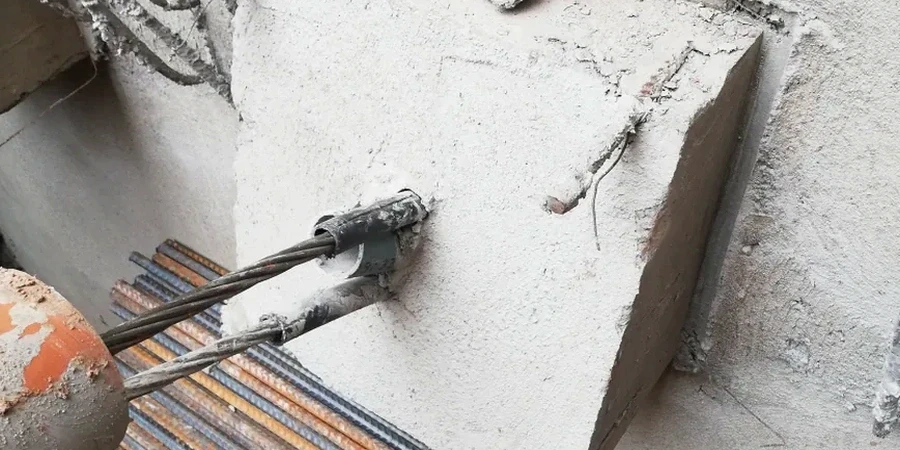
Technical reference image — Mesa

Local geotechnical context

ASCE 7-22 Section 18 and IBC Chapter 18 require that anchor design address both strength and serviceability limit states, but the real risk in Mesa is long-term creep in unsaturated sandy silts. These soils appear stable during short-duration proof tests yet lose bond slowly over months as moisture content fluctuates with monsoon rains and irrigation. A wall anchored into material that creeps at just 0.5 mm per month can accumulate over an inch of movement in three years—enough to crack a structural slab above. We specify extended-duration creep testing on sacrificial anchors for any permanent installation, holding the test load for a minimum of 60 minutes and measuring displacement at logarithmic intervals. For temporary excavation support along the Loop 202, we reduce the acceptable creep to less than 2 mm over the test period, referencing PTI DC35.1 recommendations adapted for desert soils.

Need a geotechnical assessment?

Reply within 24h.

Email: info@geotechnicalengineering.sbs

Typical values

ParameterTypical value
Design life (active anchors)50 to 75 years per IBC 2021
Typical bonded length in caliche10 to 20 ft
Lock-off load (% design load)70 to 80% for coarse soils
Grout compressive strength (28-day)4,000 to 5,000 psi
Corrosion protection gradeClass I (double protection)
Proof test load133% of design load
Creep test threshold1 mm between 1 and 10 minutes

Complementary services

01

Tieback design for retaining walls

Active pre-stressed anchors for permanent MSE and soldier pile walls, with bond lengths verified against site-specific caliche depth.

02

Excavation bracing anchors

Passive and active systems for deep excavations, including load testing protocols that meet IBC requirements for temporary shoring.

03

Slope stabilization anchoring

Tensioned rock bolts and soil nails for stabilizing cut slopes in the Usery Mountain foothills, designed for long-term creep resistance.

Regulatory framework

ASCE 7-22 Minimum Design Loads, IBC 2021 Chapter 18 Soils and Foundations, PTI DC35.1 Recommendations for Prestressed Rock and Soil Anchors

Common questions

What's the difference between active and passive anchors for a Mesa project?

Active anchors are pre-stressed after grouting and apply a deliberate force to the structure—ideal for permanent retaining walls where you can't tolerate movement. Passive anchors develop tension only when the ground starts to move, which makes them suitable for temporary excavation support or rockfall barriers. In Mesa's cemented soils, active anchors give us better control because we can lock off at a known load before the wall experiences service conditions.

How much does an anchor design and testing program cost in Mesa?

For a typical Mesa commercial project, anchor design services including load testing specifications and construction oversight range from US$1,130 to US$3,940 depending on the number of anchor rows and the complexity of the soil profile. Projects with highly variable caliche depth or near major roadways like Power Road require additional investigation, which can push toward the upper end of that range.

How do you test an anchor in caliche to make sure it won't fail?

We follow a two-stage protocol. First, a performance test on sacrificial anchors applies incremental loads up to 133% of the design load, measuring movement at each step. Second, a creep test holds the load for 60 minutes and records displacement at 1, 2, 3, 5, 6, 10, 15, 20, 25, 30, 45, and 60 minutes. If the movement between the 1-minute and 10-minute readings exceeds 1 mm, the anchor fails the creep criterion and we adjust the bonded length before production installation.
Location and service area

We serve projects in Mesa and surrounding areas.

View larger map