← Home · Foundations

Shallow Foundation Design in Mesa, AZ

Together, we solve the challenges of tomorrow.

LEARN MORE →

Mesa's desert landscape presents a unique set of challenges for any construction project. The city sits on ancient river terraces where the soil profile can shift from dense caliche hardpan to loose, wind-deposited sand within the span of a single lot. With over 300 days of sun a year and sudden monsoon downpours, the ground reacts in ways that demand precise shallow foundation design. A standard solution from Phoenix or Tucson won't account for the specific alluvial deposits found east of the Salt River. That's why every pad footing and continuous strip we design starts with a careful look at what lies beneath the surface—because a well-built home or commercial building in Mesa depends entirely on a foundation that works with the local soil, not against it.

In Mesa, the difference between a performing foundation and a failing one often comes down to how you handle the caliche layer.

Our approach and scope

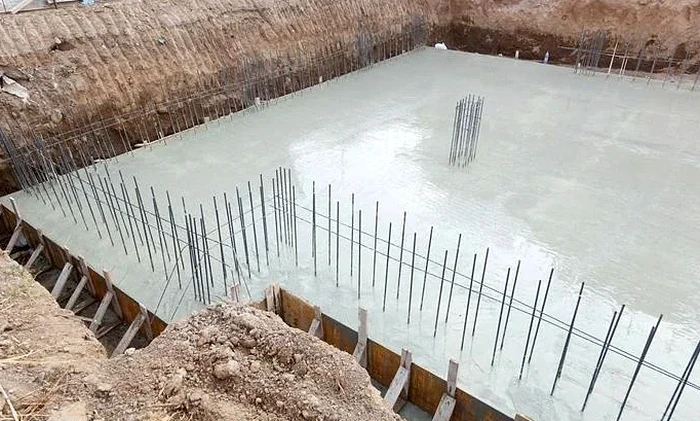
We recently worked on a commercial building off Power Road where the site investigation revealed a classic Mesa soil profile. The top two feet were sandy loam, underlain by a three-foot layer of cemented caliche that varied in thickness across the building pad. The owner wanted a fast-track schedule, so we recommended isolated square footings sized to bear directly on the caliche layer. By using field data from a plate load test right at the bearing elevation, we confirmed the allowable capacity and avoided over-excavation. We sized the footings using the general bearing capacity equation with shape and depth factors adjusted for the site, then verified settlement stayed under 1 inch total—a critical limit for the tilt-up concrete walls planned above. The subgrade variability also triggered a grain size analysis to confirm drainage characteristics before finalizing the compaction spec for the slab-on-grade.
Shallow Foundation Design in Mesa, AZ
Technical reference image — Mesa

Local geotechnical context

IBC Section 1803 requires a geotechnical investigation for every structure in the City of Mesa, and the permit office enforces it strictly for shallow foundation design. The most common failure we see isn't a sudden collapse—it's differential movement caused by underestimating the natural variability in desert soils. A footing placed half on intact caliche and half on recompacted fill will rotate as the fill consolidates under load. In Mesa's expansive soil zones, seasonal moisture changes can lift the perimeter of a slab while the interior stays put, cracking drywall and jamming doors within the first two years. The cost to underpin a settled footing far exceeds the cost of a proper investigation and site-specific design upfront. We size footings to keep bearing pressures well below the net ultimate capacity, with settlement calculations checked against both elastic theory and field-measured moduli.

Need a geotechnical assessment?

Reply within 24h.

Email: info@geotechnicalengineering.sbs

Typical values

ParameterTypical value
Typical allowable bearing pressure (caliche)3,000 – 5,000 psf
Typical allowable bearing pressure (alluvial sand)1,500 – 2,500 psf
Factor of safety (static)≥ 3.0
Maximum total settlement1 inch
Minimum footing depth (per IBC)12 inches below grade
Design life50 years per ASCE 7
Backfill compaction≥ 95% modified Proctor

Complementary services

01

Spread Footing Design

Isolated and continuous strip footings sized for Mesa's variable soil profile. We handle single-family residential, multi-story commercial, and light industrial with the same attention to bearing stratum selection and differential settlement control.

02

Post-Tensioned Slab-on-Grade Design

Stiffened slab foundations engineered for Mesa's expansive clay zones. We use the PTI method to design slab thickness and tendon layout, accommodating the edge lift and center lift modes common in the East Valley.

Regulatory framework

ASCE 7-22 (Minimum Design Loads), IBC 2021 (Chapter 18 – Soils and Foundations), ASTM D1586 (Standard Penetration Test), ASTM D2487 (Soil Classification), ACI 318 (Structural Concrete – Footing Design)

Common questions

How much does shallow foundation design cost for a Mesa project?

A typical shallow foundation design package for a single-family home or small commercial building in Mesa falls between US$2,160 and US$2,820. The final figure depends on the complexity of the soil profile, the number of borings required, and whether the city requests additional analysis for expansive soils.

What depth should footings be in Mesa?

IBC requires a minimum of 12 inches below undisturbed ground surface. In Mesa, we often go deeper—18 to 24 inches—to get below the zone of seasonal moisture fluctuation and to seat the footing in competent material. The final depth depends on what the site investigation reveals about the caliche layer and the presence of any loose fill.

Do I need a soil test before you design the foundation?

Yes. Mesa building officials require a geotechnical report with the permit application. We coordinate the drilling, log the borings, run lab tests on the samples, and use that data to design the foundation. No soil test, no permit—and no way to size the footings accurately.

What is caliche and why does it matter for shallow foundations?

Caliche is a natural cement-like layer of calcium carbonate that forms in desert soils. In Mesa, it can be a blessing or a curse. If it's thick and continuous, it provides excellent bearing capacity. If it's fractured or variable in depth, it can lead to uneven support under a footing. We map the caliche carefully during the investigation to decide whether to bear on it or remove it.
Location and service area

We serve projects in Mesa and surrounding areas. More info.

View larger map