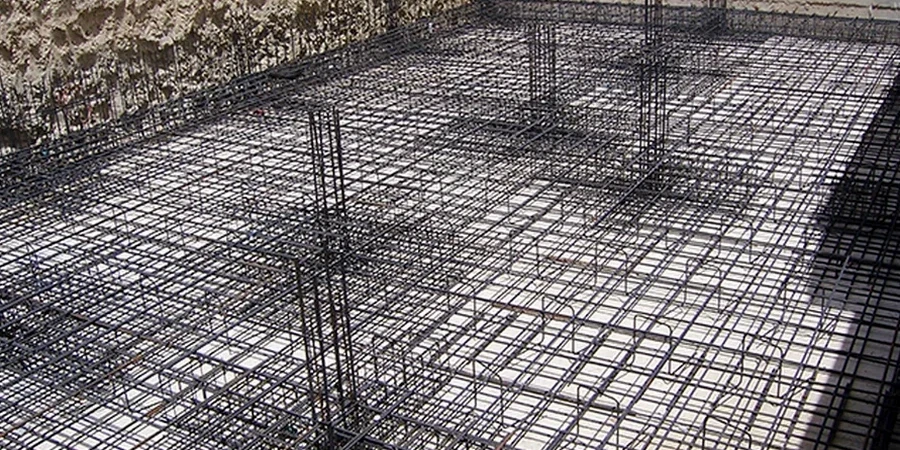
A rig places a hollow-stem auger into Mesa's desert pavement, and the crew logs caliche at four feet. That cemented layer defines the upper boundary condition for any shallow foundation system here. We design raft/mat foundations that bridge these hardpan crusts over softer basin fill, distributing column loads across a continuous reinforced slab so differential settlement stays within the ½-inch tolerance that Mesa's light-gauge steel frames demand. The interaction between the mat's flexural stiffness and the underlying alluvium—sands and gravels deposited by the ancestral Salt River—drives our reinforcement layout. For sites near the 202 freeway corridor where fill thickness varies, we often pair the mat design with test pits to verify refusal depth at each pier location before finalizing the slab thickness.
In Mesa's basin-fill geology, a raft foundation doesn't eliminate settlement—it makes settlement uniform enough that the drywall never knows it happened.
Local geotechnical context
East Mesa and West Mesa sit on different soils. The west side, closer to Tempe, has more river-channel deposits—cleaner sands, better drainage, higher allowable bearing. East of Higley Road you hit the expansive clays and the old agricultural land with undocumented fill that can contain gypsum and soluble sulfates. A raft/mat foundation design for a project near Greenfield Road has to handle shrink-swell potential with a moisture-conditioned subbase and sulfate-resistant Type V cement. The risk isn't total collapse; it's differential heave that tilts a slab corner by half an inch and cracks partition walls. We run swell-consolidation tests on undisturbed Shelby tube samples and feed the heave prediction into the mat's rigidity analysis. For sites near the Superstition Freeway where vibration from heavy truck traffic couples with sensitive silts, we check the dynamic amplification factor so the mat doesn't transmit resonant frequencies into the building frame.
Common questions
What does a raft/mat foundation design cost for a typical commercial building in Mesa?
For a single-story commercial structure up to about 10,000 square feet, the combined geotechnical investigation and mat foundation analysis typically ranges from US$930 to US$3,610. The spread depends on the number of borings required, the depth to competent bearing material, and whether specialized laboratory tests like swell-consolidation or sulfate content are necessary. Projects on East Mesa expansive clays tend toward the upper end because of the additional testing to characterize shrink-swell behavior.
How do Mesa's caliche layers affect raft foundation performance?
Caliche—the calcium-carbonate cemented hardpan common in Mesa's desert soils—acts as a stiff crust that can mask softer sediments underneath. We don't bear a raft foundation on caliche without checking what lies below it. If the caliche is continuous and at least 3 feet thick with no underlying voids or soft zones, it can deliver excellent support. If it's fragmented or underlain by collapsible silts, we design the mat to span across potential weak spots, or we recommend breaking through the caliche and founding on a moisture-conditioned structural fill pad.
Do you use post-tensioned or conventionally reinforced mats in Mesa?
We specify both, depending on the soil conditions. Conventionally reinforced mats with A615 Grade 60 rebar work well for most Mesa projects and allow easier future modifications like plumbing cuts. Post-tensioned mats make sense on highly expansive clays east of Higley Road, where the precompression helps counteract differential heave. The decision comes from the geotechnical report: if the plasticity index exceeds 25 and the swell potential is moderate to high, we lean toward post-tensioning to control cracking and reduce slab thickness.
What's the difference between a raft foundation and a stiffened slab-on-grade for Mesa conditions?
A stiffened slab-on-grade distributes wall and light column loads through thickened edges and interior ribs, typically for low-rise residential or light commercial. A raft/mat foundation is a fully engineered structural slab designed to carry heavy column loads, elevator pits, and concentrated equipment pads. In Mesa, we use stiffened slabs for single-story tilt-up buildings on decent soils, and raft/mat foundations for multi-story structures, buildings with basements, or sites with highly variable subsurface conditions where column loads exceed 200 kips.