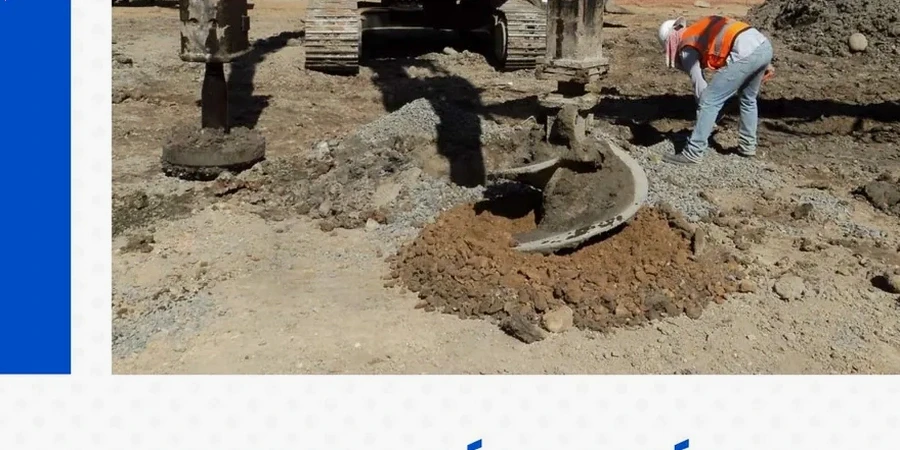
Mesa stretches from the hard-packed caliche benches near Usery Mountain down to the softer, deeper alluvium along the Salt River—and the ground conditions change fast. A warehouse site near Falcon Field might show stiff sandy gravel at 6 feet, while a subdivision off Power Road hits collapsible silts that can settle inches under foundation loads. Neither extreme responds well to a one-size-fits-all approach, which is why our in-situ permeability testing often runs parallel with stone column design to confirm drainage paths before the first aggregate goes in. The city’s rapid infill development, now pushing past 520,000 residents, keeps pushing projects onto marginal soils where conventional shallow footings become uneconomical. We approach each Mesa project by first reading the USDA soil survey sheets for the specific quarter-section, then layering in CPT logs and lab consolidation data before sizing the column grid. This isn’t just about meeting ASCE 7 bearing criteria—it’s about giving the owner a foundation that won’t need a costly retrofit five years after the certificate of occupancy.
Stone columns in Mesa aren’t just about bearing capacity—they’re about controlling differential settlement in collapsible soils that can lose 10 percent of their volume when wetted.
Our approach and scope
A recent tilt-up concrete building off Baseline Road sat on a lens of low-plasticity clay that lab tests classified as CL per ASTM D2487, with undrained shear strength dropping below 800 psf between 8 and 14 feet. The structural engineer originally called for drilled piers socketed into the stiff layer at 22 feet, but groundwater at 12 feet made drilling messy and expensive. We ran a
triaxial program on undisturbed Shelby tube samples to pin down the effective friction angle and consolidation stress history, then modeled a grid of 30-inch-diameter stone columns at 7.5-foot spacing, vibro-replacement method, penetrating through the soft clay and bearing on the dense sand below the water table. The load-transfer analysis showed the composite ground could handle 4,500 psf allowable bearing with total settlement under 1 inch—better than the pier option and with the slab-on-grade poured within two weeks of column installation. Mesa’s hot, dry climate actually helped: the contractor had zero rain delays during the rig mobilization and compaction phase. We specify column diameter, spacing, depth, aggregate gradation, and installation sequence for each project, and we stay on site for the modulus test columns to verify the design assumptions before production ramps up.
Local geotechnical context
The most common mistake we see in East Valley ground improvement is contractors treating stone columns like a commodity—ordering the rig, punching holes on a square grid, and hoping the settlement numbers work out. That gamble fails badly in Mesa’s collapsible silts and clayey sands, where the untreated soil between columns can still compress if the column stiffness ratio isn’t matched to the load distribution. We’ve walked onto sites near the Red Mountain Freeway where a warehouse slab had cracked along column lines because the design ignored the drainage function: the columns created vertical drains that accelerated wetting of the inter-column soil and triggered collapse settlement nobody modeled. A proper design sequence includes pre-treatment CPT testing for stratigraphy, lab consolidation curves on the weakest layer, unit-cell finite element analysis to check stress concentration, and modulus test columns with post-installation CPT verification. Skipping the modulus test in Mesa’s variable basin-fill deposits means you’re installing a system you can’t prove works—and the building owner won’t accept a foundation on faith alone.
Common questions
What does stone column design cost for a typical Mesa commercial building?
For a single-story commercial structure on a 20,000-square-foot footprint, the engineering design package typically runs between US$1,360 and US$5,480, depending on the complexity of the soil profile, number of CPT soundings required, and whether modulus testing is included. Projects with multiple building pads or deep collapsible layers at varied depths fall toward the upper end.
How do stone columns perform in Mesa’s collapsible soils?
Stone columns address collapsible soils through two mechanisms: the vibro-replacement process densifies the surrounding silty sand before any load is applied, and the aggregate column itself creates a stiff inclusion that carries most of the structural load, reducing stress on the inter-column soil. The drainage function also helps dissipate excess pore pressure, though it must be accounted for in the settlement model to avoid the wetting-collapse scenario.
What is the difference between stone columns and vibrocompaction for Mesa sites?
Vibrocompaction works well in clean sands with less than 15 percent fines, which exist in pockets along the Salt River corridor in Mesa. Stone columns are the right choice when the soil has more than 15 percent fines—common in the silty basin-fill deposits across most of the city—because the aggregate column replaces and reinforces the soil rather than just trying to densify it. We make the call after reviewing grain-size curves from the site investigation.
How long does the design process take from start to approved drawings?
Assuming the geotechnical investigation data is already complete, we can deliver preliminary column geometry within two weeks and final sealed drawings within three to four weeks. If we’re coordinating the CPT program and lab testing as part of the scope, add two to three weeks for field work and consolidation testing. Modulus test column verification adds roughly one week after installation for CPT comparison and report finalization.