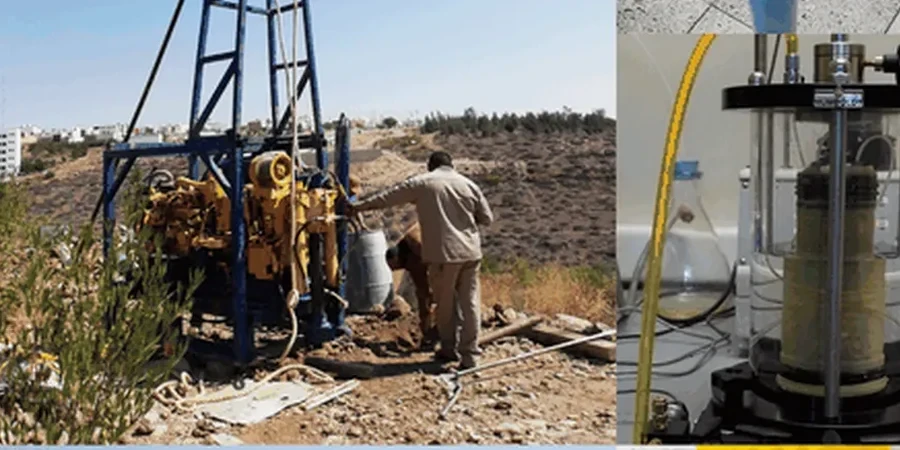
Too many Mesa builders discover reactive clay only after the slab cracks. A rushed site investigation or skipping a grain-size analysis altogether leads to expensive change orders and construction delays. We see it most often on the eastern edge of the city where alluvial fan deposits change texture within a few hundred feet. Our soil mechanics study bridges the gap between quick field samples and the detailed lab work an engineer needs to size footings correctly. We run the full program: classification, strength, and consolidation, all under one scope. For sites near the Usery Mountain foothills we often pair index testing with triaxial shear strength to handle sloping grade conditions. The goal is straightforward: deliver a geotechnical report that eliminates guesswork before the concrete truck arrives.
Caliche crust in Mesa can mask soft underlying alluvium — lab consolidation data prevents differential settlement surprises.
Common questions
How much does a soil mechanics study cost for a Mesa single-family lot?
For a typical custom home parcel in Mesa, the soil mechanics study ranges from US$2.930 to US$5.960 depending on the number of borings, lab tests, and report addenda. Lots near the Salt River corridor or in areas with known expansive clay may require extra swell testing that falls at the upper end of that range.
Does the City of Mesa require a soil mechanics report for a building permit?
Yes. The City of Mesa Development works Department enforces the International Building Code, which requires a geotechnical report for all new commercial structures and most residential projects. A soil mechanics study that provides bearing capacity, classification, and settlement parameters is the standard submittal.
How long does the full soil mechanics study take from drilling to final report?
Field drilling and sampling usually take one day for a standard residential lot. Lab testing runs 7 to 10 business days for basic classification and strength, and 12 to 15 business days if consolidation or swell tests are required. The final report is delivered the same week lab data is signed off.
What soil problems are most common in Mesa?
The three big ones are expansive clay in the basin-fill deposits, shallow caliche that varies in thickness, and collapsible soils in former agricultural zones west of Stapley Drive. A well-scoped soil mechanics study identifies all three before design so the structural engineer can address them in the foundation and site grading plans.
Do you handle both the field drilling and the lab testing in-house?
We manage the entire process. Our CME-55 drill rig handles the field sampling at your Mesa site, and our ISO 17025-accredited lab runs all index and strength tests under the same project number. This single-point responsibility speeds up the report and reduces coordination errors.