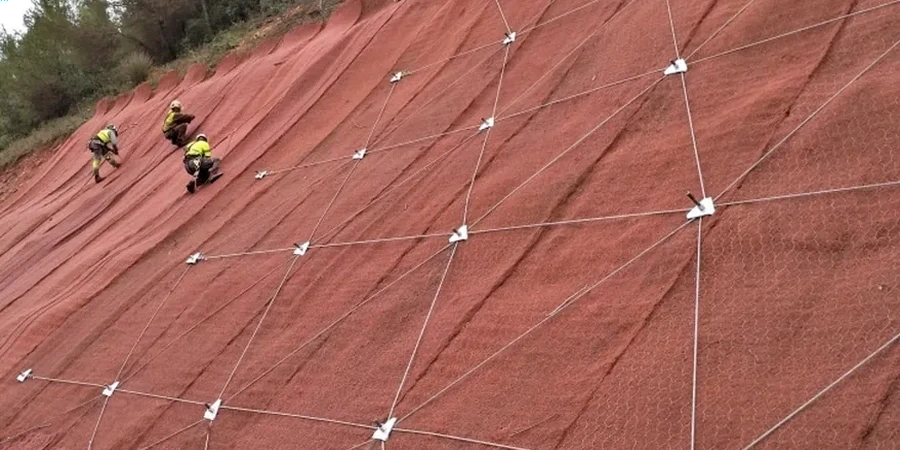
Mesa's rapid expansion into the Lehi and Eastmark areas means more construction on desert slopes and former agricultural land. The combination of collapsible soils, caliche layers, and monsoon-season saturation creates a distinct set of geotechnical challenges that standard site investigations often miss. A thorough slope stability analysis examines the factor of safety against rotational and translational failure, accounting for the specific soil stratigraphy found across Maricopa County. We work within the ASCE 7 and IBC framework to produce stability models that engineers and city reviewers can rely on. For projects in the foothills near Usery Mountain or along the Salt River's ancient terraces, understanding how the soil profile behaves under saturated conditions is not a formality—it's the difference between a subdivision that performs for decades and one that develops tension cracks after the first heavy rainfall.
A slope that stands during Mesa's dry season can fail catastrophically when monsoon moisture eliminates the apparent cohesion in silty sands.
Local geotechnical context
Mesa sits at approximately 1,240 feet elevation on a series of Pleistocene terraces, and the city's population passed 500,000 in 2023, driving subdivision construction into areas with increasingly marginal slope conditions. The most common failure trigger we document is irrigation overspray and monsoon infiltration saturating the upper five to ten feet of colluvium, which reduces matric suction and eliminates the apparent cohesion that keeps steep cut slopes standing. A single rotational failure in a retention basin embankment can expose a developer to six-figure remedial grading costs and months of permitting delays with the City of Mesa Engineering Department. The IBC requires a minimum factor of safety of 1.5 for static conditions, but sites within 50 feet of an existing structure or public right-of-way demand more conservative modeling because the consequence of failure extends beyond the property boundary. Dry utilities, perimeter walls, and stormwater infrastructure all become part of the stability assessment when the failure circle radius exceeds the slope height.
Regulatory framework
ASCE 7-22 Minimum Design Loads and Associated Criteria for Buildings and Other Structures, IBC 2021 Chapter 18 – Soils and Foundations, Section 1806 Presumptive Load-Bearing Values, ASTM D1586 Standard Test Method for Standard Penetration Test (SPT) and Split-Barrel Sampling, ASTM D2487 Standard Practice for Classification of Soils for Engineering Purposes, AASHTO LRFD Bridge Design Specifications (for cut slopes adjacent to transportation corridors)
Common questions
How much does a slope stability analysis cost for a Mesa residential subdivision?
For a typical Mesa subdivision with two to three critical cross-sections, the analysis ranges from US$1,270 to US$3,600 depending on the number of soil borings required, the laboratory testing program, and whether seismic pseudostatic analysis is triggered by the proximity to known faults. Sites requiring deep borings into caliche or multiple groundwater monitoring wells will fall toward the upper end of that range.
What triggers a slope stability review by the City of Mesa?
The City of Mesa Engineering Department requires a slope stability analysis for any cut or fill slope exceeding 10 feet in height, for any construction within the setback zone of an existing slope steeper than 3:1, and for retention basin embankments that impound more than two acre-feet of water. The threshold height drops to 5 feet if the slope is within 50 feet of a habitable structure or public right-of-way.
How do monsoon rains affect slope stability calculations?
Monsoon infiltration eliminates the negative pore-water pressure (matric suction) in the upper soil zone, which can reduce the factor of safety by 30-50% compared to dry conditions. Our models explicitly simulate a saturated front advancing into the slope face during a design storm event, using Mesa's 100-year rainfall intensity of approximately 3.5 inches in 6 hours per NOAA Atlas 14 data. This transient analysis captures the most critical condition that steady-state models miss.