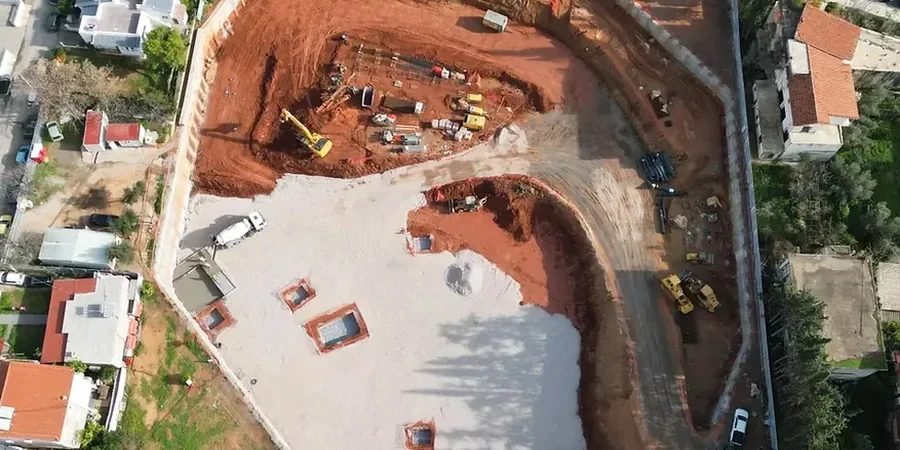
Mesa's growth from an early agricultural settlement fed by the Roosevelt Dam canals into Arizona's third-largest city has pushed construction into increasingly constrained sites. The mix of historic lots downtown and new developments pushing east into the Superstition foothills creates a unique challenge for anyone doing a deep excavation here. You're cutting through layered alluvium—sands, gravels, and the notorious caliche—with groundwater perched unpredictably. Our team has worked these soils long enough to know that a standard shoring approach won't cut it. The geotechnical design of deep excavations here requires a careful read of the subsurface data, often combining CPT soundings to profile the cemented layers with triaxial shear tests to nail down strength parameters before we even sketch a bracing layout. When you're going down 25 feet or more just a few blocks from Main Street, the margin for error is thin.
Caliche can stand unsupported for days, but introduce water and the same face can ravel in hours—we've seen it happen.
Our approach and scope
The soil profile shifts dramatically between west Mesa and the newer subdivisions near Las Sendas. Out west, you'll find older, denser river deposits with significant calcium carbonate cementation—that's the caliche that can ring like concrete when you hit it. It stands up well in vertical cuts temporarily, but it's brittle, and once groundwater seeps into a fissure, the behavior changes fast. East of Ellsworth Road, the soils are younger, less consolidated, and you'll see more interbedded silts that complicate drainage design. For a project near the Red Mountain Freeway, we specified a soldier pile and tieback system after
seismic refraction surveys mapped a buried paleochannel that didn't show up in the borings. The geotechnical design of deep excavations in Mesa demands that you verify the stratigraphy with multiple methods, because the city's geology can hide surprises between two adjacent lots. Key considerations we address in every design include lateral earth pressure distribution on shoring walls, base stability against heave in low-strength zones, groundwater control through dewatering or cutoff walls, and vibration monitoring when rock breaking is required near existing structures.
Regulatory framework
ASCE 7-22 Minimum Design Loads and Associated Criteria for Buildings and Other Structures, IBC 2021 Chapter 18 Soils and Foundations, OSHA 29 CFR Part 1926 Subpart P Excavations, ASTM D1586 Standard Test Method for Standard Penetration Test (SPT), ASTM D2487 Standard Practice for Classification of Soils for Engineering Purposes, FHWA GEC No. 4 Ground Anchors and Anchored Systems
Common questions
What are the biggest geotechnical challenges for deep excavations in Mesa?
The main challenge is the variability of cemented soils. Caliche layers can be extremely hard, requiring rock excavation techniques, but they're often underlain by loose sands or silts. Groundwater depth varies significantly across the city. We also deal with urban constraints—adjacent historic structures, utilities, and traffic—that limit shoring options and require vibration and settlement monitoring.
How much does a geotechnical design for a deep excavation cost in Mesa?
A complete geotechnical design package for a deep excavation in Mesa, including subsurface investigation, laboratory testing, shoring design calculations, and construction-phase monitoring plans, typically ranges from US$2,390 to US$7,270 depending on the excavation depth, complexity of the soil profile, and proximity to adjacent structures.
What shoring methods work best in Mesa's caliche soils?
Soldier pile and lagging walls are common and cost-effective where the caliche stands up well between piles. In weaker or water-bearing zones, secant pile walls or soil-cement mixing can deliver positive groundwater cutoff. Soil nail walls work well in competent cemented soils but require careful drilling through hard layers. The choice depends on the specific stratigraphy and site constraints.