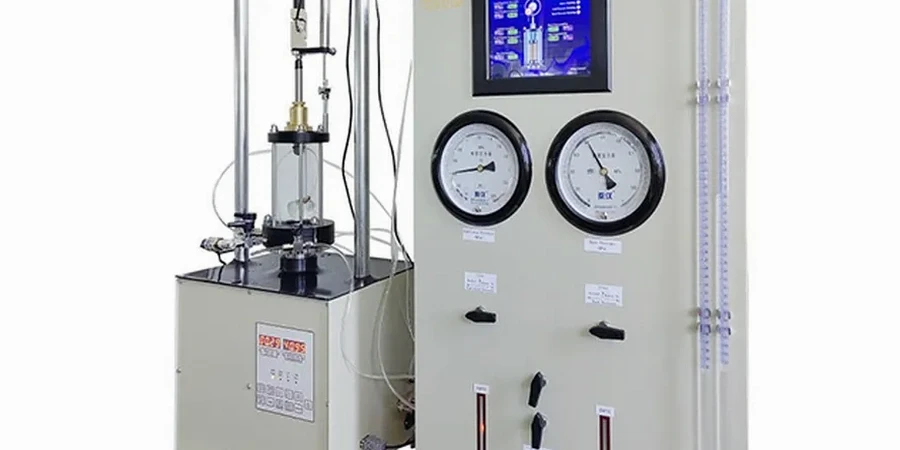
In Mesa, where the transition from the Sonoran Desert floor to the edge of the Tonto National Forest creates highly variable subsurface conditions, we often see engineers surprised by how a seemingly firm sandy layer can lose strength under saturation. The triaxial test becomes essential here because it replicates the confining pressure and drainage conditions that the soil will actually track record beneath a foundation or embankment. Rather than relying on generalized correlations from simpler index tests, a properly executed triaxial program provides the effective cohesion and friction angle needed to refine bearing capacity calculations and slope models. For projects where groundwater may rise during monsoon season, we pair this with a CPT test to identify potential weak zones, and when expansive behavior is suspected we often recommend Atterberg limits to fully characterize the fines fraction.
Desert soils in Mesa often exhibit apparent cohesion from partial saturation; triaxial testing quantifies how much of that strength disappears when the soil becomes wetted.
Local geotechnical context
With Mesa's population exceeding 500,000 and growth pushing development into areas with deeper alluvial sediments, the margin for geotechnical uncertainty keeps shrinking. Overestimating the effective friction angle by just two degrees can propagate into a footing design that is undersized, creating differential settlement problems within the first few monsoon cycles. The bigger risk, however, involves undrained loading scenarios where rapid construction or flash flooding prevents pore pressure dissipation. If the triaxial test program does not include CU protocols with pore pressure measurement, the designer may miss a contractive soil response that could lead to flow failure. The cost of a supplemental investigation after excavation problems arise dwarfs the investment in a thorough laboratory program from the start.
Common questions
What is the typical cost range for a triaxial test program in Mesa?
A standard three-specimen triaxial test program in our Mesa lab typically falls between US$1,780 and US$3,060, depending on whether you need CU with pore pressure measurement or a simpler CD setup, and factoring in the specific confining pressures and specimen preparation required.
How many specimens are needed for a reliable triaxial test?
We require a minimum of three specimens from the same undisturbed sample to construct a meaningful Mohr-Coulomb envelope. For critical projects where the failure envelope curvature is relevant, a fourth specimen at a different confining pressure can be added to improve confidence in the strength parameters.
Can you test caliche or highly cemented soils from Mesa?
Yes, but caliche requires careful specimen preparation to avoid fracturing the cementation bonds. Our technicians trim specimens slowly using a lathe and low-pressure water jet when needed, and we often run unconfined compression tests on parallel specimens to verify the consistency of the cemented structure before triaxial shearing.
What is the difference between a CD and CU triaxial test?
A consolidated-drained (CD) test allows full drainage during shear and measures effective stress parameters directly. A consolidated-undrained (CU) test prevents drainage during shear but measures pore pressure, so effective stress parameters can still be calculated. CU tests are faster and more appropriate for short-term loading scenarios on low-permeability soils.