← Home · Seismic

Base Isolation Seismic Design in Mesa: Engineering the Gap Against Arizona Ground Motion

Together, we solve the challenges of tomorrow.

LEARN MORE →

The most expensive mistake we see in Mesa is over-stiffening a structure on stiff soil. Engineers assume dense caliche means low seismic risk and skip base isolation. Then the short-period acceleration hits. The ground here transmits high-frequency energy straight into the building frame. That snaps welds and shears anchor bolts before the first visible crack appears in drywall. We design base isolation systems specifically for the site class C and D soils common across the East Valley. The isolators cut the spectral acceleration demand at the superstructure level. That changes the entire force path. We pair this with site-specific seismic refraction to nail the Vs30 profile the isolator stiffness depends on, and CPT testing where caliche layers force a change in the bearing stratigraphy under the isolator pedestals.

A base isolation system is a tuned filter. Get the soil stiffness wrong and the filter amplifies the very frequencies it was meant to block.

Our approach and scope

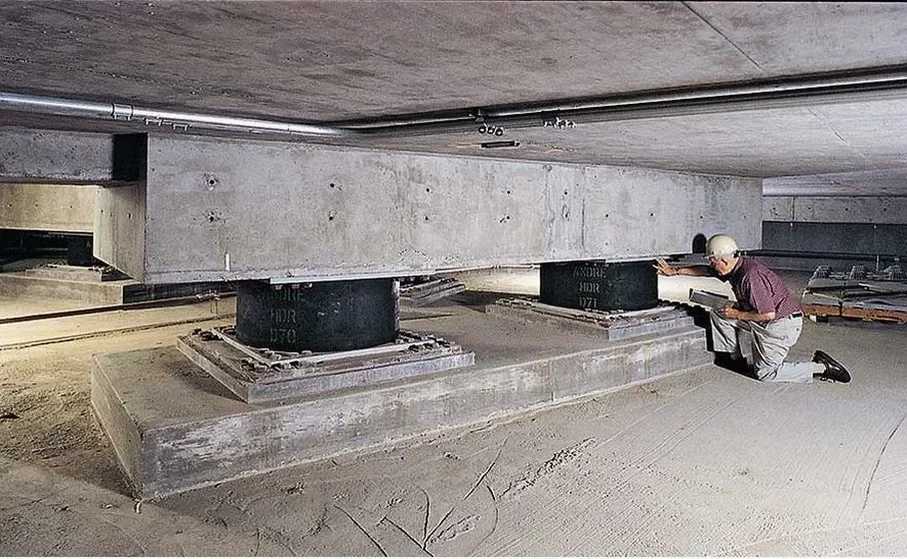
Mesa sits at 1,240 feet elevation on basin-fill deposits with cemented caliche horizons that vary from zero to eight feet thick within a single lot. That creates a brutal stiffness contrast under a foundation. A rigid base on caliche behaves completely differently from a rigid base on sandy alluvium. The isolator bearings must be tuned to the actual stiffness profile, not a generic site class assumption. We model the soil-structure interaction using the IBC Chapter 16 amendments adopted by the City of Mesa. Our approach selects lead-rubber or high-damping rubber bearings based on the displacement demand calculated from the MCE_R spectrum. An isolator with the wrong effective stiffness amplifies rather than filters the ground motion. We always run the full nonlinear time-history when the near-source factor pushes the design into a corner period that linear static analysis can't capture. Before finalizing the isolation plane, we often combine results with a liquefaction assessment because the loose sand lenses at depth under the Salt River floodplain can trigger cyclic mobility that undermines the isolator pedestal stability.
Base Isolation Seismic Design in Mesa: Engineering the Gap Against Arizona Ground Motion
Technical reference image — Mesa

Local geotechnical context

ASCE 7-22 Chapter 17 mandates a peer review for any base-isolated structure assigned to Risk Category III or IV. Mesa has multiple critical facilities that fall into this category. The reviewer will challenge the isolator prototype test data if the soil profile is not documented with site-specific borings. You cannot rely on the USGS web service alone. The near-source factor can shift sharply if the closest fault segment is reclassified during the project design phase. We have seen a change of 0.08g in SMS appear between schematic design and construction documents because of updated fault mapping along the Salt River zone. That small shift can push the isolator displacement past the moat clearance allowed in the architectural drawings. The consequence is a redesign of the entire isolation plane and a six-figure change order. The only way to control that risk is to build conservatism into the displacement demand from day one and lock the geotechnical parameters early with a comprehensive field investigation.

Need a geotechnical assessment?

Reply within 24h.

Email: info@geotechnicalengineering.sbs

Typical values

ParameterTypical value
Design basis earthquake (DBE) return period475 years (10% in 50 years)
MCE_R spectral acceleration at T=1.0s (S1)0.20–0.25g (approximate Mesa range)
Site class range in MesaC to D (very dense soil to stiff soil)
Isolator effective period (target)2.5–3.5 seconds
Design displacement demand8–15 inches (caliche-dependent)
Minimum isolator vertical stiffness≥ 10× horizontal effective stiffness
Applicable ASCE 7 chapterChapter 17 — Seismic Isolation

Complementary services

01

Isolator System Design and Nonlinear Analysis

We select and model the isolator units using the bilinear hysteresis parameters required by ASCE 7. The analysis includes the upper- and lower-bound property variations to envelope the maximum displacement and force demands on the structure above the isolation plane.

02

Peer Review and Prototype Testing Support

We prepare the design basis report, the isolator performance specification, and the response to reviewer comments. We specify the prototype test sequence per ASCE 7 Section 17.8 and review the test data against the design assumptions before approval.

Regulatory framework

ASCE/SEI 7-22 Minimum Design Loads and Associated Criteria for Buildings and Other Structures, IBC 2024 (adopted by City of Mesa with local amendments), ASTM D7400 Standard Test Methods for Downhole Seismic Testing, AASHTO Guide Specifications for Seismic Isolation Design (where applicable to bridge structures)

Common questions

When is base isolation required instead of a fixed-base design in Mesa?

Base isolation becomes the preferred solution when a fixed-base design cannot meet the drift limits or force demands in ASCE 7 without massive structural members that compromise the architectural program. It is also mandated by some federal agencies for essential facilities regardless of the site class.

How does the caliche layer affect isolator selection?

Caliche is very stiff at small strains. It creates a high initial stiffness under the isolator pedestal. If that stiffness is not captured in the soil springs, the isolator period shifts shorter than predicted. We use downhole seismic and CPT data to define the caliche geometry and adjust the bearing stiffness matrix accordingly.

What is the typical cost range for base isolation design on a Mesa commercial project?

For a mid-rise commercial building in Mesa, the complete base isolation design package including nonlinear analysis and peer review support typically ranges from US$4.230 to US$8.970 depending on the complexity of the isolation plane and the number of required time histories.

Does the City of Mesa require a geotechnical investigation specific to base isolation?

Yes. The City of Mesa amendment to IBC Chapter 18 requires a site-specific geotechnical investigation that addresses the dynamic soil properties for any structure using seismic isolation. A generic report with SPT blow counts alone will not be accepted.
Location and service area

We serve projects in Mesa and surrounding areas.

View larger map