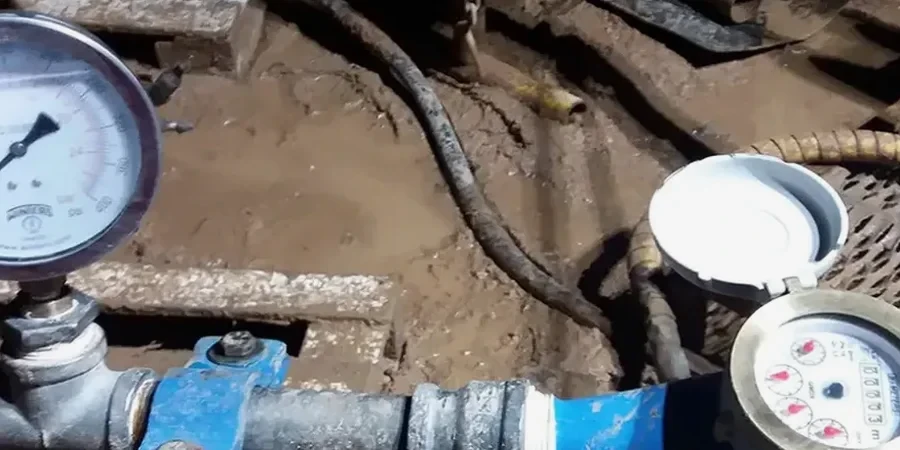
A recent mixed-use development off Power Road hit groundwater at 18 feet during excavation, triggering an emergency dewatering redesign that stopped work for ten days. In Mesa's basin-fill geology, perched water lenses and cemented caliche layers create permeability contrasts that borehole logs alone cannot resolve. That is where field permeability testing (Lefranc/Lugeon) becomes essential. Our team runs these in-situ tests to measure hydraulic conductivity directly within the formation, giving the geotechnical engineer real numbers for seepage analysis, dewatering pump sizing, and cutoff wall design. We follow ASTM D6391 for the Lefranc method in granular soils and the Lugeon protocol in fractured or cemented zones, ensuring the data holds up under review by the City of Mesa Development works and the Maricopa County Flood Control District.
A Lefranc test gives you a single defensible number for hydraulic conductivity; a Lugeon pattern tells you whether the fractures are self-healing or opening under pressure.
Local geotechnical context
The equipment we mobilize for Mesa projects centers on a truck-mounted drill rig with automatic hammer for SPT advancement, coupled with a dedicated permeability test kit that includes a submersible pressure transducer, pneumatic packer assembly, graduated reservoir with flow meter, and data logger recording pressure and flow at one-second intervals. The biggest failure mode we see is packer bypass in caving boreholes drilled through Mesa's sandy-gravel lenses; if the packer seal leaks, the test yields a falsely high conductivity that can lead to undersized dewatering systems. We mitigate this by advancing casing to refusal in the test interval and verifying seal integrity with a short shut-in pressure decay before starting the test sequence. The second common pitfall is running Lugeon stages without allowing sufficient time for pressure equilibration in low-permeability caliche, which produces non-representative Lugeon values and a misleadingly linear flow-pressure relationship.
Common questions
What does a field permeability test cost in Mesa, and what factors affect the price?
For Mesa projects, a standard Lefranc or Lugeon test typically runs between US$720 and US$940 per test interval, depending on depth, access conditions, and whether the borehole is already drilled. Mobilization within the East Valley is included; sites in outlying areas like east of Signal Butte Road may incur a modest travel surcharge. The main cost drivers are the number of test intervals required by the geotechnical engineer, the need for double-packer setups in fractured rock, and extended test durations in low-permeability caliche where flow stabilization takes longer. We deliver a fixed-price proposal after reviewing the boring plan and site geology so there are no surprises when the invoice arrives.
When is a Lugeon test required instead of a Lefranc test?
The Lugeon test is the appropriate choice when the test interval intersects fractured or jointed material where discrete fractures control the bulk permeability, rather than the intergranular pore space. In Mesa, this typically means the cemented caliche layers in the upper basin fill, basalt flows encountered in the eastern foothills near the Superstition Wilderness boundary, and decomposed granite at depth. The Lugeon method applies stepped pressures to differentiate between laminar flow through tight fractures, turbulent flow through open joints, and hydraulic dilation where fractures open under injection pressure. A Lefranc test in these materials would under-represent the true mass permeability because it does not capture fracture connectivity. The geotechnical report for any project with a retained cut in fractured caliche or a deep foundation bearing on basalt should specify Lugeon testing to support the groundwater control design.
How long does a field permeability test take, and what access do you need?
A single Lefranc test interval in Mesa's typical sandy-gravel deposits takes about 45 to 90 minutes once the borehole is drilled to target depth and the packer is set. Lugeon tests with five pressure stages run longer, typically 90 to 150 minutes per interval, because each stage requires flow stabilization at constant pressure before moving to the next step. We need drill rig access to the test location with a level working platform, and a water source capable of delivering 5 to 10 gallons per minute for the test duration. In Mesa's summer heat, we schedule permeability testing in the early morning when possible, both for crew safety and because water temperature fluctuations in surface storage tanks can introduce viscosity corrections if testing runs into the afternoon. The borehole should be advanced by a drill crew familiar with the test protocol so casing is set cleanly and the test interval is not smeared with drilling mud.